
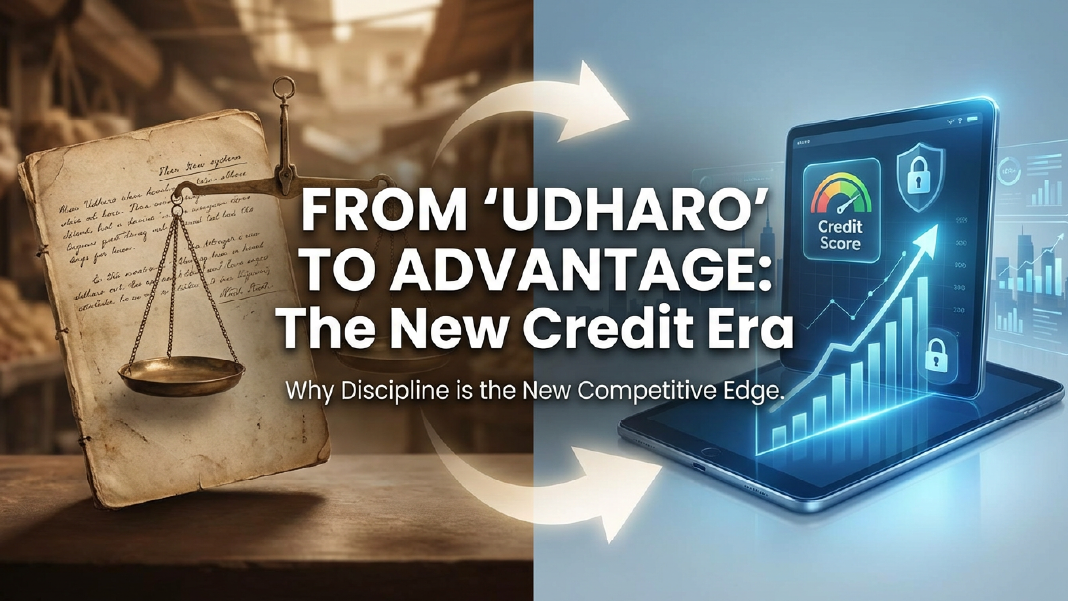
The ‘Udharo’ Culture Shift: Why Credit Discipline Is Becoming a Competitive Advantage
For generations, udharo was more than a financial practice in Nepal; it was a social contract. From local kirana pasals to service providers, trust replaced paperwork. Payments were delayed, names written in notebooks, and relationships mattered more than timelines.
That system worked when communities were small, transactions limited, and reputations traveled faster than money. But Nepal’s economy and credit ecosystem have changed.
Today, Udharo is evolving. And in that shift, credit discipline is quietly becoming a competitive advantage.
From Social Trust to Recorded Credit Behaviour
Traditional udharo worked because it relied on proximity and familiarity. Everyone knew everyone, and reputation travelled through conversations.
Today, reputation travels through data.
Loans, credit cards, digital wallets, BNPL services, and even supplier payments now create records. Payments are time-stamped, delays are logged, and patterns are visible. What once depended on goodwill is now supported, and sometimes replaced, by measurable behaviour.
This shift isn’t about abandoning trust. It’s about scaling it. When transactions increase, and relationships stretch beyond neighbourhoods, systems step in to do what memory can’t.
Why Discipline Now Matters More Than Ever
In today’s credit ecosystem, repayment behaviour influences access more than most people realize. Late EMIs, irregular card payments, or repeated delays do not always trigger immediate penalties, but they quietly reshape future eligibility. Credit limits shrink, approval timelines lengthen, and options narrow — often without clear explanation.
Conversely, disciplined credit behaviour creates leverage. Individuals with consistent repayment histories face fewer barriers when applying for loans or requesting higher limits. Businesses that demonstrate reliability gain negotiating power with both lenders and suppliers. Credit discipline, in this sense, is no longer a personal virtue; it is a practical advantage that directly affects financial mobility.
Predictability has become a form of value — and institutions price it accordingly.
.png)
The Shift Is Most Visible in Small Businesses
The impact of this transition is particularly visible among small and medium businesses. Informal udharo arrangements are increasingly being replaced by defined credit periods, digital invoices, and clearer payment terms. This change does not reflect a loss of trust, but a response to tighter margins, faster cash cycles, and increased competition.
Businesses that honour payment timelines are rewarded in subtle but meaningful ways. They receive quicker service, better pricing, and greater flexibility during periods of strain. Those who delay payments are rarely confronted directly; instead, they are deprioritized when resources become limited.
In competitive markets, reliability becomes a differentiator, often more powerful than size, visibility, or long-standing relationships.
Digital Records Have Changed Reputation
Earlier, reputation lived primarily in conversations. Today, it lives in records.
Bank statements, transaction histories, repayment logs, and digital invoices collectively tell a story long before any meeting takes place. Financial institutions read that story before approving loans, increasing credit limits, or extending new facilities. Even outside formal banking, vendors and service providers increasingly assess clients based on documented payment behaviour rather than personal familiarity.
In a digitized economy, financial trails speak before people do.
Why This Is a Cultural Shift, Not a Moral One
This change is not about declaring Udharo wrong. It is about acknowledging scale.
What worked in a low-volume, relationship-driven economy struggles in a fast-moving, credit-based one. The cost of delay is higher, competition is tighter, and tolerance for ambiguity is lower.
Credit discipline, therefore, is not about rigidity; it is about predictability. And predictability builds trust faster and more reliably than promises.
Credit Discipline as a Competitive Advantage
Those who adapt to this shift gain an edge. Individuals with disciplined repayment histories access better financial products and face fewer obstacles over time. Businesses with clean payment records grow faster, negotiate more effectively, and withstand downturns with greater resilience.
In an environment where credit is widely available but selectively priced, behaviour determines opportunity. That is the quiet shift happening beneath the surface of Nepal’s evolving credit culture.
Looking Ahead
The udharo culture that shaped Nepal’s informal economy was rooted in trust, patience, and mutual understanding. Those values have not disappeared, but the environment in which they operate has changed.
As credit becomes measurable and financial behaviour increasingly recorded, trust must travel further and faster than before. Systems now carry the weight that relationships once did, rewarding those who act predictably and consistently over time.
The message is not to abandon tradition, but to adapt it.
In modern Nepal, the most trusted borrowers are no longer those who promise well, but those who repay on time.