
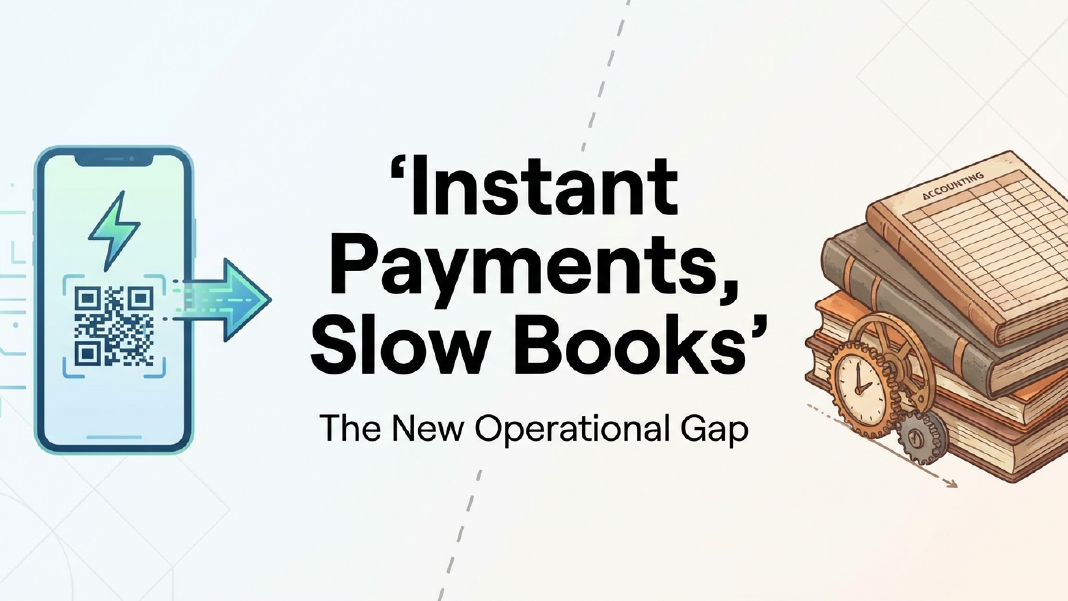
Payments Are Instant, But Books Are Not: The New Gap Between Money Movement and Record Keeping
For many Nepali businesses, getting paid has become faster than ever. Customers can pay you via mobile banking, QR codes, wallets, or direct bank transfers in seconds. Money reaches your bank account almost instantly.
But inside the office, your finance and accounts team is facing a very different reality. Money moves in real time, but books get updated later, sometimes at the end of the day, sometimes at the end of the month.
That creates a new operational gap: instant payments vs slow, manual record keeping. It is not just an inconvenience. It affects reconciliation, reporting, and the confidence to make day-to-day decisions based on the real cash position.
In this post, we’ll look at why this gap exists for Nepali SMEs, the risks it creates, and what helps close it.
Nepal’s Payments Moved Faster Than Bookkeeping Systems
In Nepal, payment innovation has accelerated quickly. QR and wallet payments are now common in retail, F&B, and services. Mobile and internet banking let customers transfer funds to their accounts at any time. ConnectIPS and interbank transfers move money faster than ever across banks.
For your customers, this is a win: they can pay you quickly and conveniently. For your internal team, however, each new payment method adds more work. There are more sources of transaction data to monitor, more reference formats to decode, and more complexity when matching payments against invoices and orders.
Meanwhile, your core accounting setup, whether it’s Tally, a legacy ERP, or spreadsheets, still assumes an older reality. It expects transactions to come in predictable daily or monthly batches. It assumes someone will manually download and review bank statements. It relies on a staff member updating the books at the end of the day or during the month-end.
That mismatch between real-time payments and slow, manual bookkeeping is the heart of the problem.
How This Gap Shows Up in Daily Operations
Here’s how this gap shows up in day-to-day operations for trading, distribution, retail, and service businesses in Nepal.
1) Instant cash movement, delayed visibility
A customer pays via QR code or online transfer, and the funds hit your bank account quickly. But your books may not reflect it until someone:
- Logs into bank portals
- Downloads statements
- Updates Excel/Tally/legacy software
- Matches deposits with invoices
So owners and managers end up making decisions using yesterday’s view.
2) Multiple channels, scattered records
A growing SME may receive payments via cash, cheque, bank transfer, QR codes, wallets, and gateways. Each comes with different timings, charges, and narration styles.
But the business needs one clear view:
- Who paid
- For which invoice or order
- How much was received after charges
Without that, teams spend time calling customers, checking screenshots in WhatsApp, and guessing which deposit belongs to which bill.
3) Reconciliation becomes a continuous backlog
In theory, reconciliation is simple. In reality, it becomes messy when you deal with:
- Many small payments
- Unclear references
- Partial settlements
- Bank charges and adjustments
The result is predictable: reconciliation gets delayed, month-end becomes stressful, and small mismatches quietly pile up.
.png)
Why This Gap is Risky For Growing Businesses
The payment–bookkeeping gap isn’t just an internal operations problem. It creates real risk for SMEs trying to grow in a competitive market.
1. Confusion about real cash position
If your books are not updated in line with your bank, it’s hard to answer:
- How much cash do we really have today?
- How much is from customer advances, and how much is free to use?
- How much is committed to suppliers or EMIs?
In an environment where credit is tight and interest costs matter, making decisions on outdated numbers can be expensive.
2. Slower, less accurate reporting
Owners and investors increasingly expect:
- Faster closing of monthly accounts
- Clearer dashboards on sales, collections, and payables
- More frequent cash-flow and aging reports
But if your team is spending hours each week downloading bank statements and cleaning Excel files, they have less time for:
- Cash-flow planning
- Credit control and follow-up
- Scenario analysis and budgeting
3. Higher error and compliance risk
When processes are manual, especially across multiple banks and payment channels, the risks go up:
- Mistyped figures in Excel
- Missed receipts or duplicate entries
- Weak audit trails on who changed what, and when
As your transaction volume grows, these minor issues can become bigger problems: disputes with customers, audit difficulties, and a lack of confidence in the numbers.
4. Burnout and frustration in finance and operations
Your finance and operations teams want to add value. But many still spend a large share of their week on:
- Downloading and merging bank statements
- Checking SMS and email alerts for payments
- Updating ledgers manually
- Chasing missing invoice numbers
This is tiring, repetitive work — and it makes it harder to retain good people in finance and operations.
What’s Really Causing The Disconnect?
If we step back, the gap comes from two trends moving at different speeds:
Payments are getting faster and more digital. Customers expect instant or same-day payments. QR, mobile banking, and online transfers are now standard.
Finance systems and processes are still slow and manual. Many SMEs still use basic accounting software plus Excel. Integrations with banks and payment channels are limited or absent.
Between these two is a missing layer: the system that connects your payment channels with your accounting and operations.
When this “connective tissue” is weak or manual, you end up with:
- Real-time payments on the front end
- Delayed, spreadsheet-based accounting on the back end
.png)
How Nepali SMEs Can Start Closing the Gap
The solution is not to slow down payments or avoid new channels. The solution is to bring your record-keeping and ERP closer to the speed and complexity of your cash flows. Here are some practical principles.
1. Treat payments data as core business data
Payment entries should not live as scattered bank lines that get “adjusted later.” They should be captured in a structured way, linked to customers and invoices.
2. Automate the routine, standardize the messy
A modern ERP approach, like Providhy, should reduce the time spent on downloading statements and manual posting. The goal is to surface only the exceptions that need human judgment.
3. Move from monthly to continuous reconciliation
Instead of waiting for month-end, aim for frequent checks with a clear view of unreconciled items. Month-end should become a final review, not a crisis.
4. Invest in a flexible integration layer
Avoid one-off, rigid integrations that break every time the bank changes its format. A modern ERP like Providhy should help you create an integration layer that is:
- Decoupled – can handle changes from banks and payment partners without breaking your ledgers
- Configurable – allows finance and operations teams to adjust mappings and rules without heavy IT support
- Auditable – keeps a clear log of how each transaction was processed and posted
This layer allows you to safely adopt additional digital payment channels without multiplying manual work.
5. Build clarity into day-to-day questions
Your system should make it easy to answer:
- Where did this payment come from
- Which invoice does it clear
- What fees were deducted
- What is the real cash position today
This is where modern tools like Providhy can help by connecting invoices, orders, bank activity, and ledgers into one consistent view.
From Instant Payments to Instant Understanding
Payments in Nepal are already close to instant. The next phase of finance and operations won’t be defined by speed alone, but by which businesses can combine instant money movement with timely, accurate, connected records.
Right now, many SMEs live with a gap between what customers experience, instant payments, and what internal systems can support, delayed books. Closing this gap is both a technical and strategic opportunity. Better, faster reporting leads to sharper decisions. Real-time visibility into cash strengthens resilience. Automated reconciliation frees your team to focus on collections, planning, and growth.
Payments have entered the real-time era. It’s time your books and your ERP did too.